

GENESIS - Solid State Power Amplifiers from Advantech Wireless Technologies
When a so-called “new” product is released to the market and labeled as the “Next Generation”, the presumption is that this new release is a continuation of the previous generation where perhaps some new bells and whistles were added, or maybe a few gremlins were exorcised. But more times than not – the core platform remains essentially unchanged.
It’s far less common that a manufacturer takes a clean sheet of paper and architects a ‘start-from-scratch’ product – a fresh approach that incorporates the best parts, technologies and processes available. A product that satisfies the needs and wants of the most discriminating customers with features, performance and reliability that are unsurpassed.
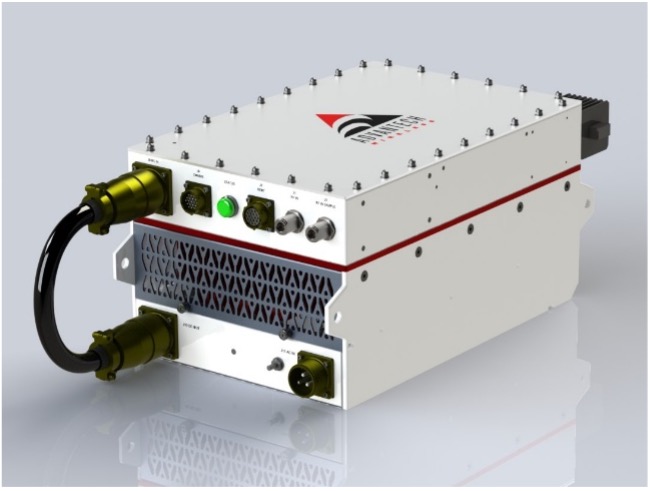
As the name implies, Genesis amplifiers from Advantech Wireless Technologies embody this premise – a brand-new state-of-the-art line of Solid-State Power Amplifiers with ‘top-of-the-line’ internals - from the power modules to the power supplies to embedded monitor & control.
Genesis was created by an engineering team with decades of experience in the design and manufacture of high-power solid-state power amplifiers predominantly used in satcom ground stations.
The Genesis line includes a range of models that generate 150 watts, 200 watts, 250 watts and 300 watts of Ku-band and C-band RF output power – models that share a common enclosure-footprint with field- removable power supplies. All are based on common building blocks that are inventoried to facilitate quick deliveries.
The Genesis HP line adds 400-watt and 500-watt variants in a larger case – also based on the same building blocks that make up the junior series.
The Genesis Platform
At the core of Genesis amplifiers is a sophisticated operating platform based on the Controller-Area-Network-Bus protocol (CAN-Bus) for internal monitoring and control processing. Originally developed for the automotive industry, CAN-Bus is a highly reliable operating system that is designed to perform a multitude of tasks in parallel.
AWT’s CAN-Bus-based Genesis Platform provides a host of features that go beyond its inherent efficiency and reliability, including:
- The ability to perform advanced diagnostics down to the subcomponent level to identify precise failure points.
- Supports advanced system redundancy architectures without the need for an external remote-control unit:
- Point of Control Unit - where the amplifiers act as virtual system remote control units.
- Flying Point of Control - will automatically switch between any amplifiers in the system for the ultimate M&C redundancy (if the POC unit goes offline, another unit in the system will automatically take over POC control).
- Out-of-the-box embedded Web M&C negates the need to install third-party computer software. Web pages are dynamically populated based on the unit's configuration.
- M&C is addressable for an individual amplifier or the full system.
- Intuitive system-level mimic panels can be configured for complex redundancy systems.
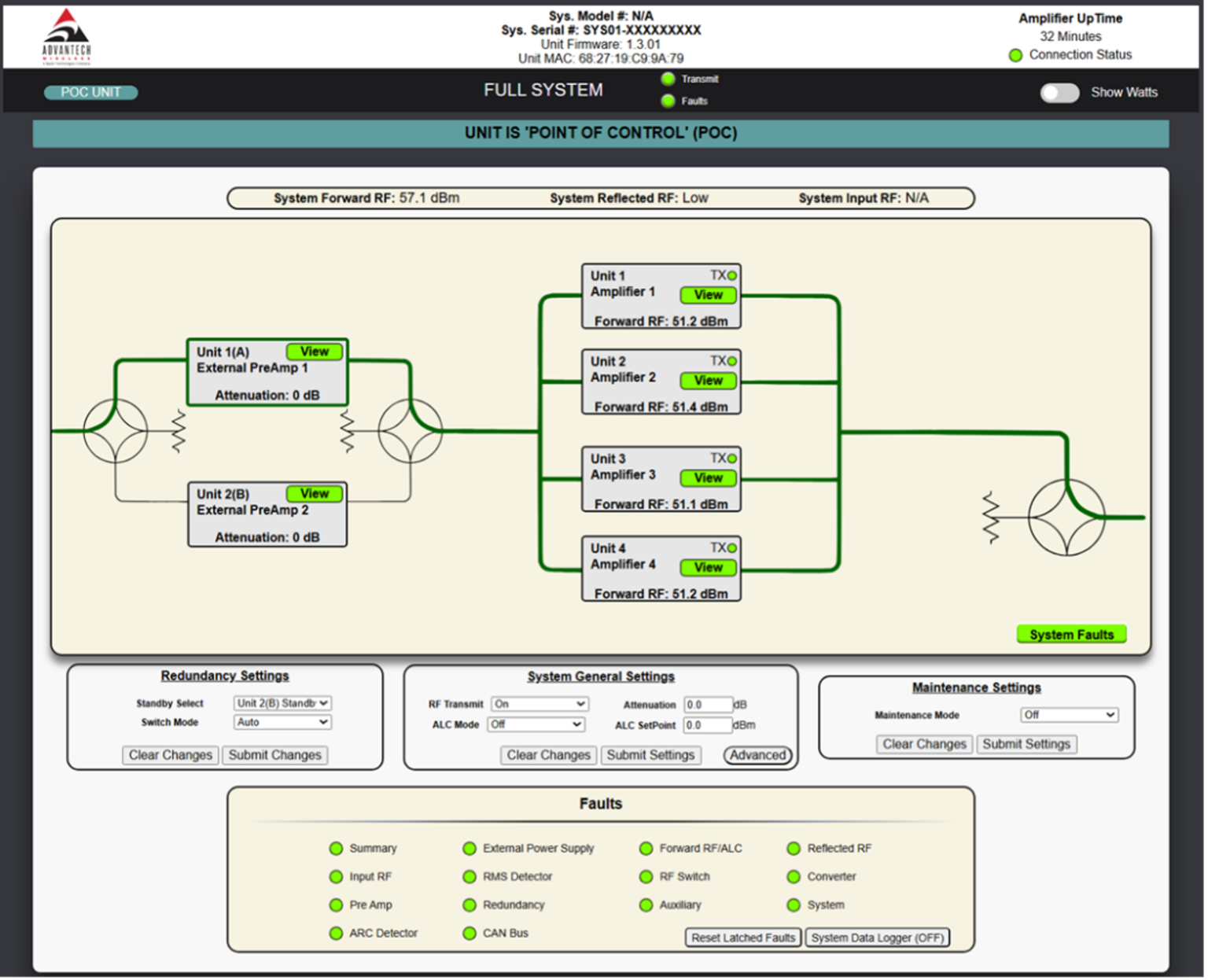
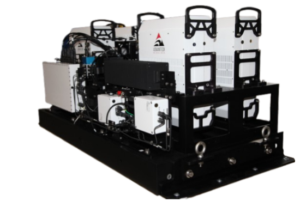
- Shown below is a system with 1:1 Input Modules driving a 4-amp Phase Combined system and an Antenna/Load switch) that was deployed to support NASA’s Artemis Moon Exploration Network.
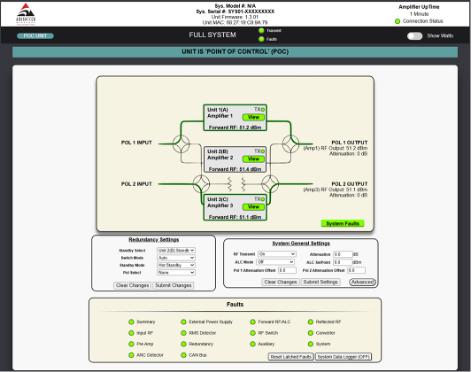
Another example is shown below – this time a 1:2 redundant system:
- Also included is the ability for in-field reconfiguration so a unit can be used in multiple redundant scenarios using a self-guided configuration wizard or a custom file upload – no need to ship back to the factory. An advanced diagnostic report generator assists the factory with troubleshooting by providing a txt file that contains all settings and conditions – a file that can be sent to AWT for analysis.
- SNMPv3 for secure M&C links
- In-field firmware update capability
- Modular design approach allowing the amplifier to be used anywhere from a Standalone unit up to a 16-unit phase combined N+1 system.
AWT amplifiers that reside outside of the Genesis family have been fitted with Genesis Master Controller boards to facilitate a CAN-Bus infusion. Phase-combined high-power systems fitted with Genesis Master Controllers have been deployed in a number of government and military programs and have logged years of service history. But the full list of features can only be achieved with Genesis amplifiers.
A restricted-access portal in Genesis amplifiers provides customer support engineers with visibility of software settings of both the amplifier and the peripheral devices (Preamp, Converter, Bias Boards, Switch Controllers, Arc Detectors, Power Detectors, etc.). This allows the factory to manipulate fault thresholds for things like temperature, voltage limits, RF Power limits), component configurations, fault configurations, even changing the LO frequency and OCXO tuning. This allows full reconfiguration and customization even after the units are deployed.
Summit III
Summit III, the latest release of the high-power, soft-fail redundant amplifier systems, is powered by Genesis amplifiers for an unparalleled degree of power and performance. Arranged in 4, 8 or 16-amplifier architectures, Summit can deliver over 6kW of RF output power with ‘hitless’ redundancy and hot swappable maintainability that drives MTTR and MTBF to their highest levels.
Summit III includes a compact frame that will accommodate a battery of Genesis amplifiers, along with redundant BUCs (if needed), control-data distribution, phase-combining waveguide, RF passives and hardware.
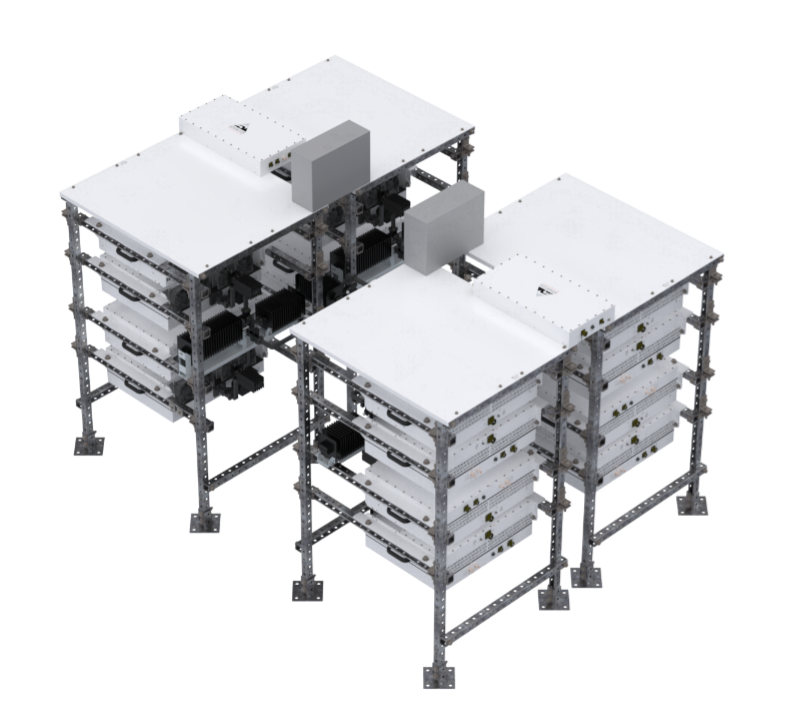
The embedded CAN-Bus platform provides all of the features and operability available within the Genesis Platform. Four, eight or sixteen amplifiers operate in a soft-fail redundancy mode such that the failure of a single amplifier will prompt a gain adjustment in the remaining amps to compensate as a way to maintain constant RF output from the system. Modularity allows the user to remove an amplifier from the system while in operation virtually eliminating downtime.
The system appears as a single amplifier on the M&C GUI, but operators can easily drill down to individual amplifiers – or even individual components, including the FETs.